Because they could complement antibiotics, researchers worldwide are working with bacteriophages, bacteria-infecting viruses. The first preparations containing these bacterial killers are already in clinical development. A study is also expected to begin in Germany soon.
Antibiotic therapies are increasingly failing because the disease-causing bacteria have developed resistance. With fatal consequences: in the USA alone, approximately 23,000 people die each year from infections with multidrug-resistant pathogens. According to a recent publication, approximately 33,000 deaths in the EU in 2015 were attributable to multidrug-resistant pathogens (DOI: 10.1016/S1473-3099(18)30605-4). In 2017, the World Health Organization (WHO) compiled a list of the twelve most dangerous pathogens. This list includes resistant strains of Acinetobacter baumannii and Pseudomonas aeruginosa, as well as Enterococcus faecium, Staphylococcus aureus, and Helicobacter pylori.
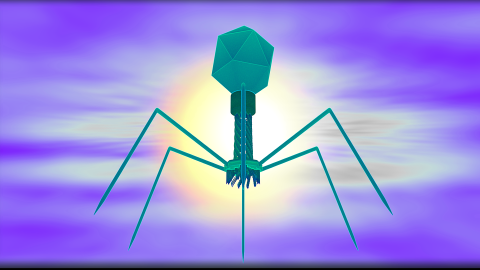
Due to the serious resistance situation, scientists are searching for new ways to eliminate dangerous pathogens such as these. Viruses can become allies in this effort. Special viruses, called bacteriophages, infect strains of a specific bacterial species with high specificity, use them for reproduction, and kill them. These viruses are present wherever it is warm and moist: in ponds, rivers, and oceans, but also in the intestines of humans and animals or on mucous membranes. They are the most widespread organisms on Earth.
In individual cases, these bacterial killers are already being used therapeutically. In May, a research team from London and Pittsburgh reported in the journal “Nature Medicine” on a personalized phage therapy using genetically modified viruses to treat an infection with antibiotic-resistant mycobacteria in a young girl with cystic fibrosis (DOI: 10.1038/s41591-019-0437-z). The patient had been receiving antibiotics for eight years due to chronic colonization with Mycobacterium abscessus. Since the pathogen no longer responded to any antibiotics, the treating physicians decided to search for suitable phages and found them in a phage collection: they assembled a cocktail of three bacteriophages, one of which they genetically modified to be lytic, causing the bacterial cells to burst. Through treatment with the cocktail, the physicians were able to rapidly control the infection.
Momentum for Phage Research
Individual cases such as this are giving phage research momentum. Phage therapies were widespread in Europe and the USA in the pre-antibiotic era, but rapidly lost significance in the West following the discovery of effective antibiotics. In Eastern Europe and Russia, these therapies are still used today. Since approximately 2000, the research field has been revived in the West, driven by the antibiotic crisis but also by the new possibilities offered by sequencing technologies, reports Charles Schmidt in a review article in “Nature Biotechnology” (DOI: 10.1038/s41587-019-0133-z). Universities in the USA are establishing research centers and creating extensive phage libraries. In 2018, the Center for Innovative Phage Applications and Therapeutics (IPATH) at the University of California, San Diego was launched, and the Center for Phage Technology (CPT) has existed at Texas A&M University in College Station since 2010. However, the largest phage library is located at the University of Pittsburgh. It comprises 15,000 isolates, of which 3,000 are fully sequenced. The three phages used in the cystic fibrosis patient also came from this collection.
According to Schmidt, phage libraries are currently being inundated with requests for critically ill patients in whom antibiotics no longer work. When suitable variants are found, they can be used with a type of special authorization from the US regulatory authority FDA as an “Emergency Investigational New Drug.” However, instead of treating individual cases, there are also efforts to bring phage-based preparations to market as approved drugs. “A first wave of clinical trials” is rolling in, writes Schmidt.
In developing such drugs, there are principally two strategies that depend on the diversity of the target bacterium: for pathogens with low diversity such as Staphylococcus aureus, fixed cocktails with three to four phages can be developed that can be produced and stored like other drugs. For genetically very diverse species such as Acinetobacter baumannii, this approach is not suitable because too many phages would have to be combined, which can interact with each other. Here, an individualized approach, i.e., the selection of suitable phages for each patient, is necessary.
Source and more information: https://www.pharmazeutische-zeitung.de/bakterienkiller-in-der-klinik/