
Bacteriophages: The Precise Solution Against Bacterial Infections
Bacteriophages are the natural antagonists of bacteria and are found everywhere in our environment. In medicine, they are referred to as “intelligent drugs” because they independently recognize and specifically eliminate pathogens. This biological precision enables effective therapy even when conventional antibiotics no longer work.
Fact Check: Why Bacteriophages Are Safe
-
Natural Occurrence: Phages are the most abundant organisms on Earth and have regulated the bacterial balance in nature for millions of years.
-
Maximum Safety: Due to their biological structure, phages can exclusively infect bacteria; human cells remain completely unaffected.
-
Lock-and-Key Principle: Each phage is specialized for a very specific bacterial strain (host specificity), enabling highly selective therapy.
Clinical safety and efficacy are continuously validated through decades of expertise at the Georgian Eliava Institute and through modern European manufacturing standards (GMP).


How Bacterial Elimination Works
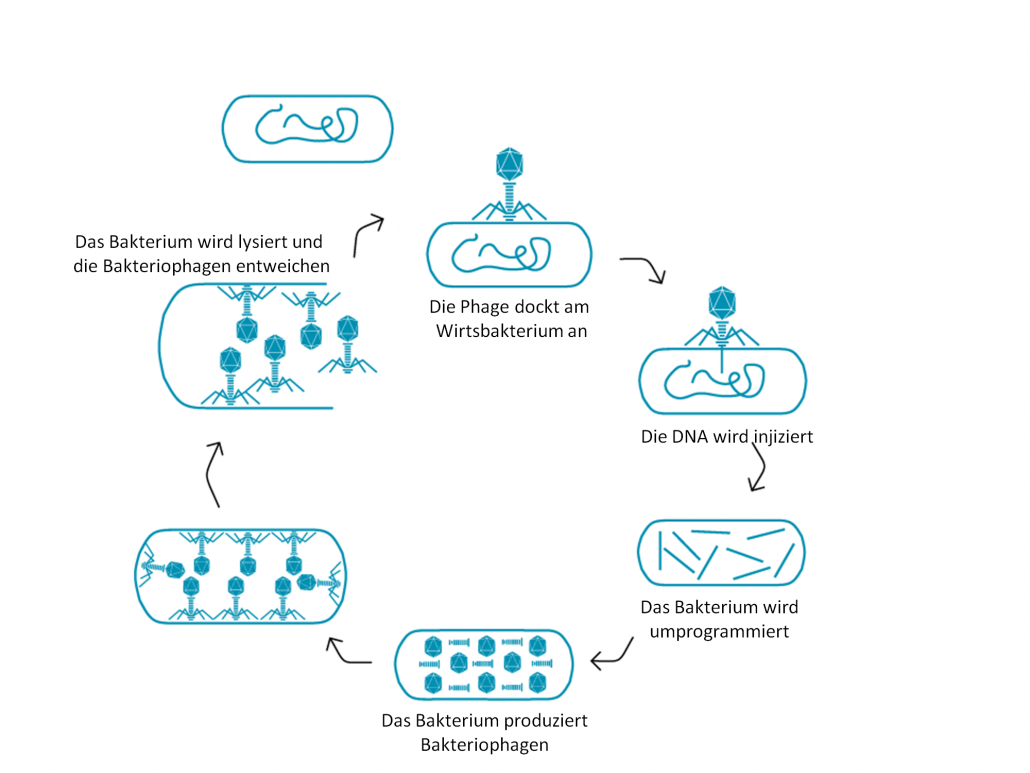
Bacteriophages work like biological precision tools. Their goal is the complete neutralization of pathogenic bacteria through the so-called lytic cycle:
-
Recognition & Binding: The phage lands on the surface of the bacterium. It uses specific receptors to ensure it has found the correct target.
-
Injection: Like a biological syringe, the phage injects its genetic information into the interior of the bacterial cell.
-
Replication: The bacterium is reprogrammed and now produces thousands of new phage copies. At this stage, phages use enzymes such as depolymerases to actively break down protective bacterial barriers (biofilms).
-
Lysis (Dissolution): Once enough copies are present, the phage causes the bacterial cell to burst. The new phages are released to seek out additional pathogens in the environment.
Phages vs. Antibiotics: A Comparison
| Feature | Conventional Antibiotics | Therapeutic Phages |
| Spectrum of Activity | Broad-spectrum (also kills beneficial bacteria) | Highly specific (only the target pathogen is killed) |
| Microbiome | Weakening of intestinal and skin flora | Preservation of healthy bacterial flora |
| Resistance Development | Risk of new multidrug resistance | Phages adapt evolutionarily |
| Biofilm Degradation | Often ineffective against protective layers | Effective destruction of biofilm matrix |
The History of Phage Therapy
Bacteriophages were discovered in 1917 by French microbiologist Felix d’Hérelle. Through his research, he recognized their effect against pathogenic bacteria and proposed using these bacteriophages for the prevention and treatment of infectious diseases.
In the 1930s, many laboratories and pharmaceutical companies began developing and producing bacteriophages for medical applications.
However, with the discovery of antibiotics in the 1930s, interest in bacteriophages waned, as antibiotics killed all microbes and were easier to produce than bacteriophage products. Consequently, phage therapy fell into obscurity.
Only a few scientific centers in Eastern Europe continued their work with bacterial viruses.
With the emergence of multidrug-resistant pathogens, interest in bacteriophages has increased again.
Which Infections Could Be Treated with Bacteriophages?
In Eastern Europe, bacteriophages are used in adults and children for the prevention and treatment of the following diseases:
• Bacterial infectious diseases of the gastrointestinal tract (enterocolitis, gastroenterocolitis, salmonellosis, shigellosis, dysbacteriosis, etc.);
• Bacterial diseases of the ears, oral cavity, throat, bronchi, and lungs (otitis, stomatitis, periodontitis, sinusitis, pharyngitis, laryngitis, tonsillitis, tracheitis, bronchitis, pleurisy, pneumonia, etc.);
• Bacterial eye diseases (conjunctivitis, keratoconjunctivitis, etc.);
• Surgical infections (treatment of surgical and infected wounds, abscesses, phlegmons, furuncles, carbuncles, etc.)
• Burns
• Urogenital infections (cystitis, urethritis, colpitis, pyelonephritis, etc.).
Bacteriophages are used both independently and in combination with other antibacterial agents.
Phage therapy is particularly useful when the pathogenic bacterium is resistant to antibiotics or when the patient is intolerant to antibiotics.
In Eastern Europe, bacteriophages are administered in liquid form. The bacteriophages are applied to infected sites through topical application, irrigation, or instillation.
FAQ
Are Bacteriophages Dangerous to Humans?
No. Bacteriophages are highly specialized viruses that exclusively use bacterial cells as hosts. Since they possess no receptors for human, animal, or plant cells, they cannot infect them. Clinically, they are considered one of the safest therapeutic methods in modern infectious disease medicine.
How Do Phages Find Their Target Bacteria?
Phages move through random collisions and bind via their tail fibers according to the lock-and-key principle to specific proteins or sugar structures on the bacterial surface. Only when the structure matches exactly is the lytic process initiated, which virtually eliminates treatment errors.
Why Are Phages Only Now Becoming Better Known in the West?
Due to the discovery of antibiotics, phage research in the West fell into the background in the mid-20th century. In light of the global antibiotic resistance crisis, phages are now being reevaluated through modern clinical trials according to EU standards and the successes of personalized medicine (compounded formulations).


