
Phages and Antibiotics: An Effective Combination Against Resistant Bacteria?
Modern medicine faces one of its greatest challenges: the gradual loss of antibiotic effectiveness. What was once considered a miracle weapon is increasingly losing ground in the fight against highly adaptive bacterial strains. However, in the world of microbiology, there is a glimmer of hope based on an alliance of two unequal partners. The Phage-Antibiotic Synergy (PAS) could be the key to escaping the dead end of multi-drug resistance.
Summary: Key Takeaways
-
Synergistic Effect: The combination of bacteriophages and antibiotics often works significantly more powerfully than the sum of individual therapies.
-
PAS Mechanism: Certain antibiotics stimulate bacteria to produce more phages, which accelerates the destruction of the pathogen.
-
Resistance Reversal: Phages can force bacteria to abandon their antibiotic resistance to escape the viral attack.
-
Precision: While antibiotics often target the entire microbiome, phages act as “surgical” tools against specific strains.
-
Individual Customization: The combination is highly specific – not every antibiotic harmonizes with every phage (necessity of a phagogram).
1. The Global Crisis: Why We Need New Antibiotic Resistance Solutions
Since the discovery of penicillin by Alexander Fleming in 1928, antibiotics have drastically increased human life expectancy. However, bacteria are masters of evolution. Through horizontal gene transfer and natural selection, they have developed mechanisms to neutralize chemical agents.
Today, we speak of the global resistance crisis. Hundreds of thousands of people already die annually from infections with so-called “superbugs” like MRSA (Methicillin-resistant Staphylococcus aureus) or carbapenem-resistant Enterobacteriaceae. The development of new antibiotic classes is economically risky and technologically difficult. This is where Bacteriophage Therapy comes in – a method that uses biological antagonists to exploit the weaknesses of bacteria.
2. What are Bacteriophages? The Natural Enemies of Bacteria
Bacteriophages (phages for short) are viruses that exclusively infect bacteria. They are the most abundant biological entities on Earth – found in the ocean, soil, and our own bodies.
The Lytic Cycle: How Phages Kill
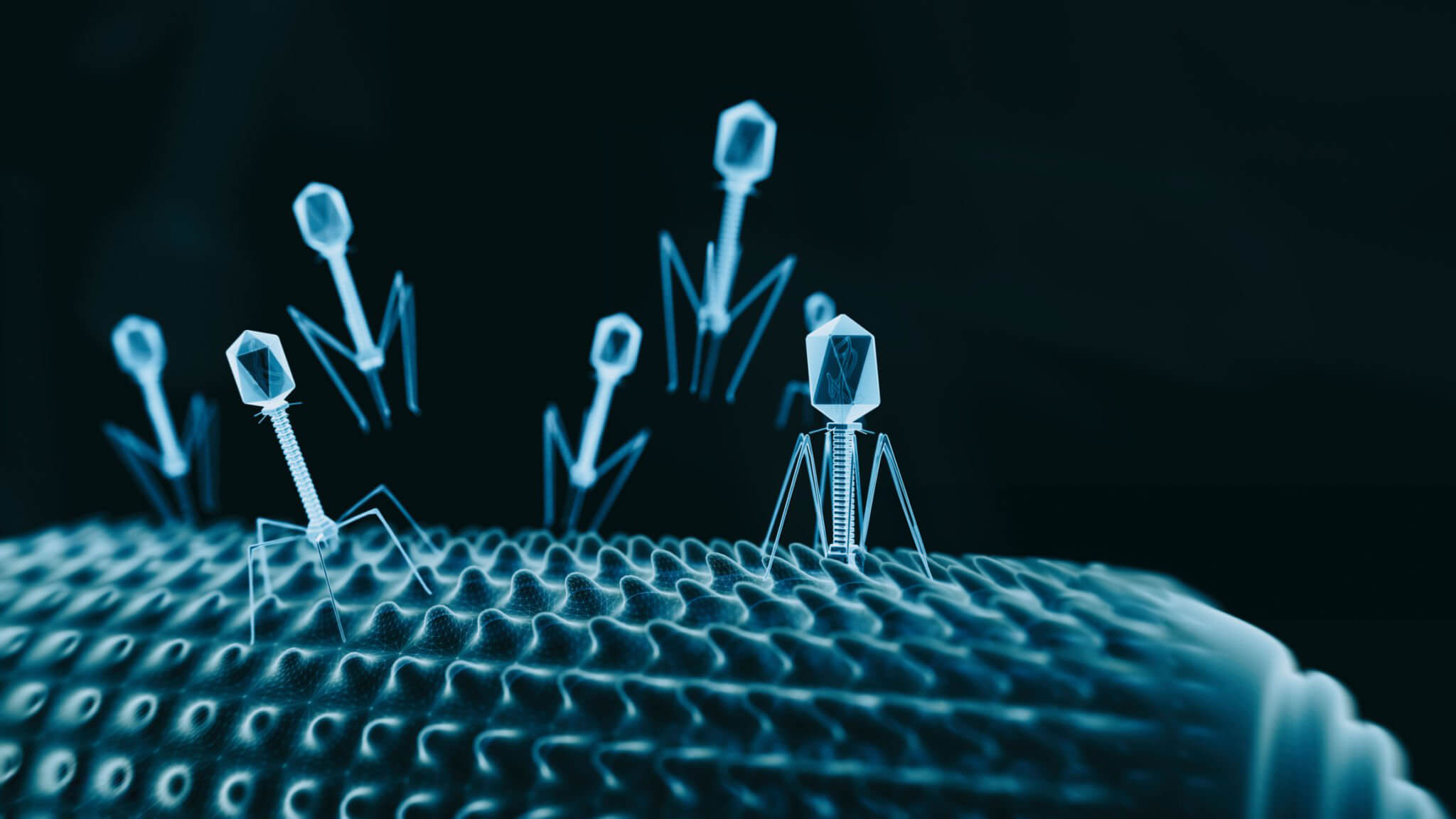
A phage functions like a biological hypodermic needle. It attaches to specific receptors on the bacterial surface and injects its genetic material. The bacterium is then reprogrammed: instead of dividing itself, it now produces hundreds of new phages. At the end of this process, the bacterial cell bursts (lysis), releasing the new viruses, which immediately attack neighboring bacteria.
Digression: The History – Why We Almost Forgot Phages
In Eastern Europe, particularly in Georgia, phages were never abandoned. While the West fully committed to the industrial production of antibiotics after World War II, the Eliava Institute in Tbilisi remained the world center for phage research. Today, patients from all over the world travel there when Western medicine has reached its limits. We are now learning to combine this ancient knowledge with modern genomics.
3. The Focus: Phage-Antibiotic Synergy (PAS) in Detail
The combination of phages and antibiotics is not merely a “double attack.” It involves a complex biological interaction known as Phage-Antibiotic Synergy (PAS).
How Does PAS Work Scientifically?
Scientific studies, such as those by Gu Liu et al. (2020), show that certain antibiotics at sublethal concentrations (doses that do not yet directly kill the bacterium) alter the bacterial cell. This change often leads to an increase in bacterial volume. A larger bacterium offers a greater surface area for phages and can simultaneously produce a higher number of phage progeny (higher “burst size”).
The Evolutionary “Trade-off”
This is perhaps the most exciting aspect: bacteria under combination therapy face enormous evolutionary pressure. To become resistant to phages, they often have to alter their surface structures (such as efflux pumps, which expel antibiotics from the cell). This means that if the bacterium learns to escape the phage, it often simultaneously becomes sensitive to the antibiotic again. This “evolutionary trap” makes it almost impossible for germs to develop dual resistance.
4. Study Analysis: Synergies and Pitfalls
The study on the combination of phages and antibiotics clarifies that effectiveness strongly depends on the chosen antibiotic class.
Positive Interactions
-
Beta-lactams: These antibiotics disrupt cell wall synthesis. The study shows that they inhibit cell division and force bacteria into filamentous forms, which massively accelerates phage proliferation.
-
Quinolones: In moderate doses, they can also induce PAS by triggering stress responses in the bacterium that favor viral replication.
The Importance of the Environment
A critical point of research is the influence of the physiological environment. While impressive synergies are measured in the lab (in vitro), factors such as urine, blood plasma, or mucous membranes can affect phage activity. This underscores the need for clinical monitoring and individual tests (phagograms) before therapy begins.
5. Advantages of Combination Therapy Over Monotherapy
Why shouldn’t we just take phages? The combination offers strategic advantages:
-
Faster Pathogen Elimination: The time to sterility is significantly reduced.
-
Biofilm Penetration: Many chronic infections (e.g., in cystic fibrosis or prosthetic infections) are protected by biofilms. Phages possess enzymes (depolymerases) that “eat away” at this biofilm, allowing the antibiotic to penetrate deep into the bacterial colony.
-
Reduction of Antibiotic Dose: PAS often allows for lower amounts of antibiotics to be used, minimizing toxic burden on the kidneys and liver, as well as damage to the gut flora.
6. From Theory to Practice: Where Do We Stand Today?
In Germany and the EU, phage therapy is currently mostly only possible as an individual compassionate use (according to the Declaration of Helsinki). This means that patients only gain access when all standard therapies have failed.
Personalized Medicine
Every patient requires a “tailor-made” phage. On Phage.help, you will find information on the importance of a phagogram – a test that determines in the laboratory which phage effectively kills the patient’s bacterial strain. The combination with antibiotics is increasingly becoming the gold standard in specialized centers.
7. Outlook: The Future of Infectiology
The future lies not in discovering a new “super-pill,” but in the intelligent combination of existing resources. Synthetic biology now even allows phages to be genetically modified to specifically disable resistance genes in bacteria.
Integrating Phage-Antibiotic Synergy into clinical routine could revolutionize how we treat multidrug-resistant germs. It is a move away from “shotgun antibiotic administration” towards precise, biologically founded medicine.
FAQ – Frequently Asked Questions
1. Can I take phages and antibiotics simultaneously? Yes, in many clinical cases, this is even recommended. Phages biologically attack the pathogen, while the antibiotic chemically weakens it. However, it is important that this occurs under medical supervision, as the timing of administration can be crucial.
2. Why do some antibiotics work against phages? Some antibiotics stop bacterial protein synthesis so abruptly (bacteriostatically) that the bacterial cell can no longer produce new phages. In this case, the active substances would hinder each other. Therefore, the choice of antibiotic is crucial.
3. How safe is phage-antibiotic synergy? Phages are highly specific and do not attack human cells. The greatest risks involve a so-called Herxheimer reaction if too many bacteria die simultaneously and release toxins. However, combination therapy is generally considered very safe.
4. Where can I find doctors who perform this combination therapy? There are specialized centers, for example, in Berlin (Charité) or in countries like Belgium and Georgia. Information on contact points can be found on our information page.
5. Does PAS also help with chronic wounds? Especially there! Chronic wounds are often covered by biofilms, against which antibiotics alone are powerless. Phages can break down these barriers and massively accelerate healing in combination with local antibiotic administration.
Conclusion for Patients and Relatives
The diagnosis of “multidrug-resistant” is no longer a death sentence. Research into Phage-Antibiotic Synergy shows us that by cleverly utilizing bacteria’s natural enemies, we possess a highly effective weapon. If you or a loved one are affected, inform yourselves early about the possibilities of phage therapy as a supplement to conventional treatment.
Further Links:

Author: Elena Kastner
Elena Kastner is an experienced specialist journalist focusing on health communication. Her focus is on evidence-based reporting and quality assurance of medical information in the digital space. With her expertise, she bridges the gap between scientific depth and practical applicability.


